A beverage filling plant started its conveyor line the wrong way once. Section three started first, the bottles piled up at the dead section, and the shift lost ninety minutes to what the production manager called "a tiny logic issue." A tiny logic issue with a 2 AM callout attached to it.
Conveyor control looks like a ladder of motors. It is not. It is a sequence with safety interlock responsibilities, and the difference between a system that starts cleanly and one that jams is the order in which the sections are started and the rules that stop them.
Start Against the Flow, Stop With the Flow
Put the sequence onto paper before the program. A five-step start plan written on a whiteboard takes ten minutes and catches the "we forgot section 2" failure before it costs a shift, and it gives the electrician a diagram the PLC never needs.
The first rule of conveyor logic is backwards from intuition: start the section furthest downstream first, then the next one upstream, and so on. The furthest section has nowhere to send its load, so it must be ready before anything feeds it. A three-section line starts as section 3 → section 2 → section 1, with an On-Delay between each step so motors do not all slam on together — that staggered inrush also spares the transformer and the local grid.
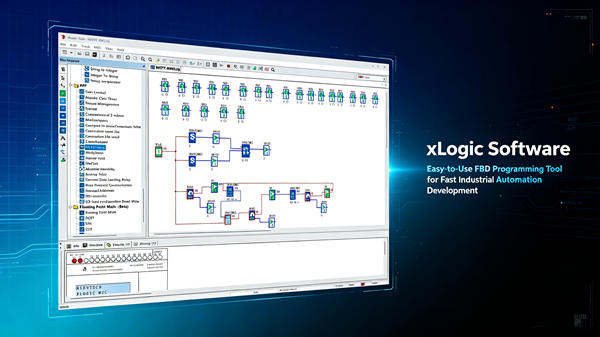
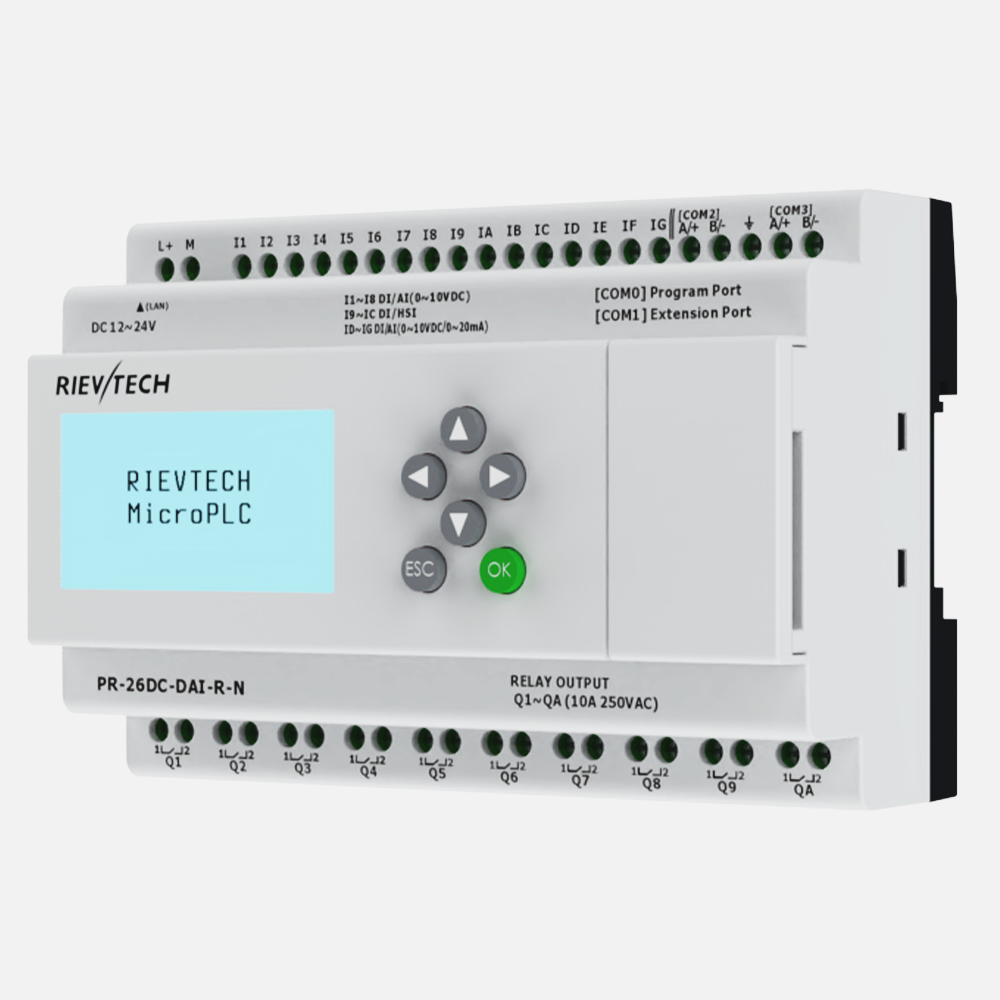
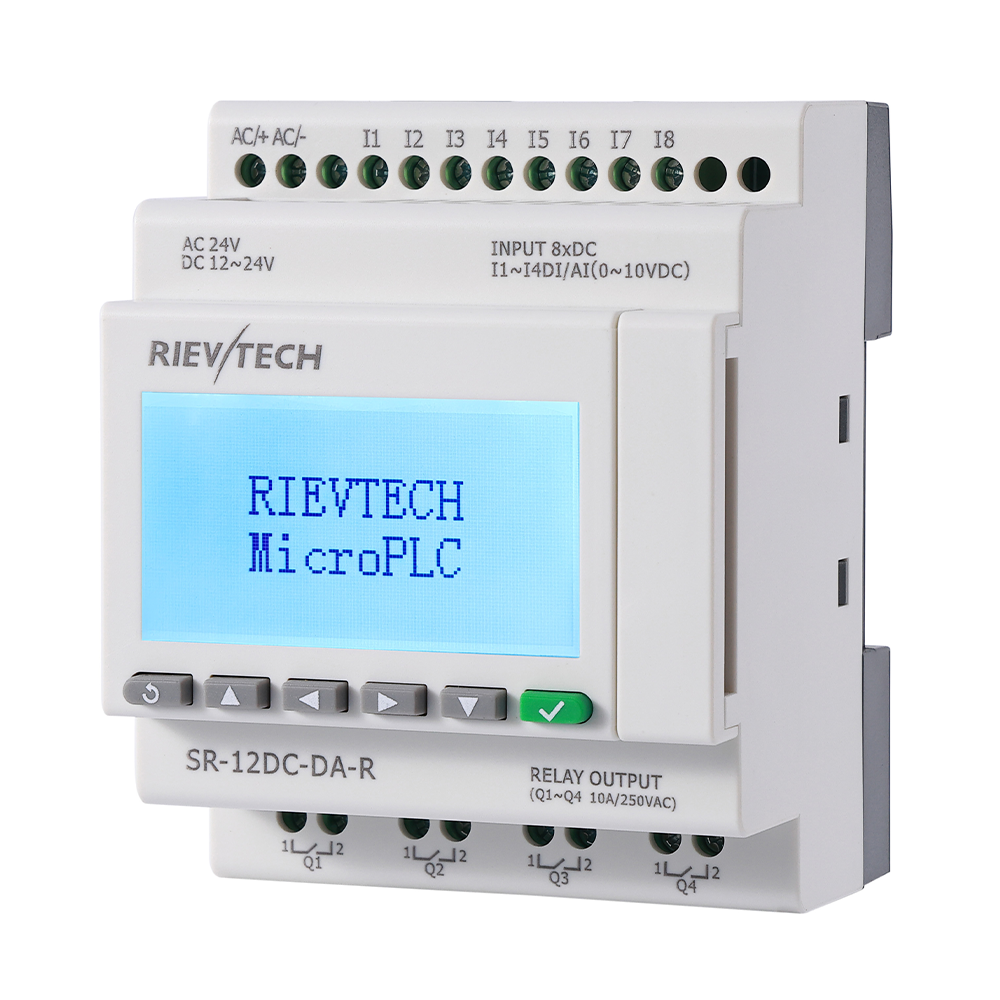
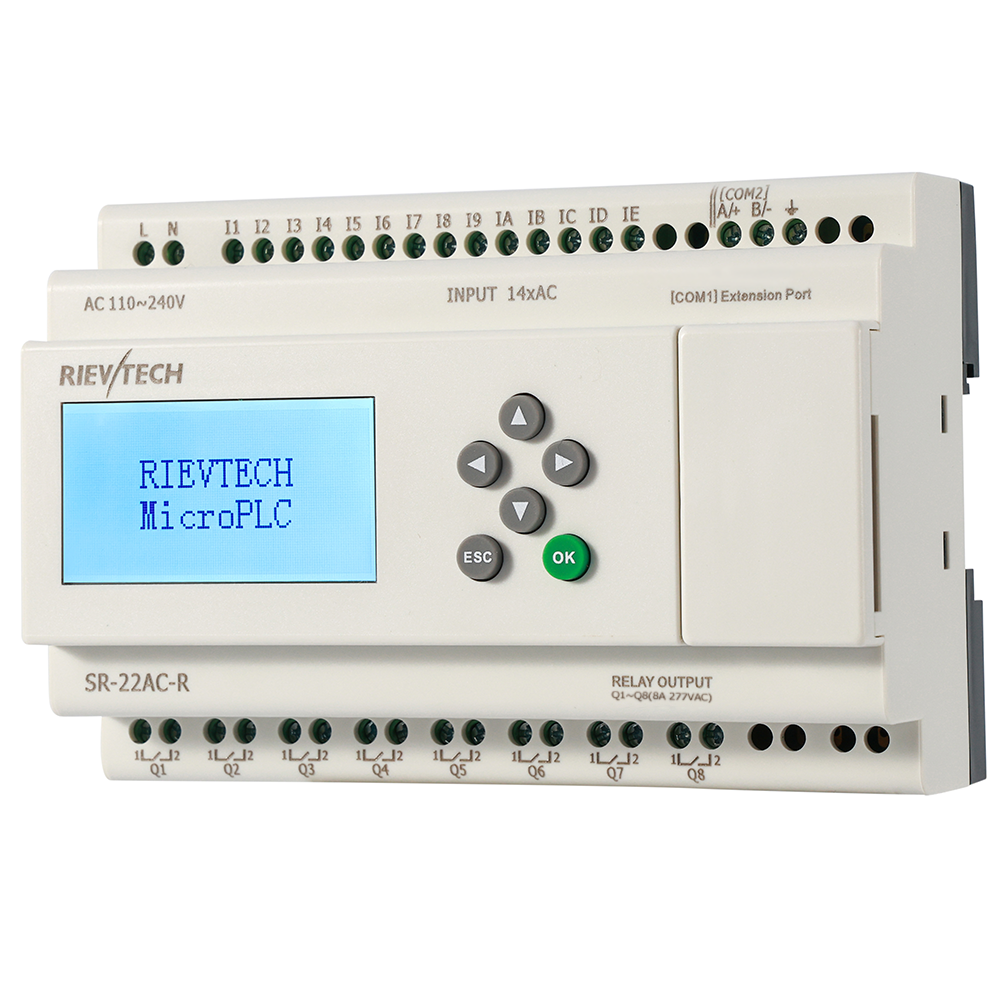
Stopping is the opposite: stop upstream first, let the downstream sections clear, then stop them. An emergency stop, by contrast, kills everything simultaneously — that is the one case where politeness is a mistake. The interlock logic on a PR-26DC-DAI-RT-N does this with a handful of timers and F flags, and the sequence position is visible on the front LCD, which is a luxury nobody expects from a control panel until they need to know "which section is holding the line right now."
Interlocks That Prevent the Mess
A jam sensor on each transfer point is the classic protection: if product backs up at section 2, the upstream section stops feeding until the jam clears, and a counter records how often it happens. Three jams in an our and the controller flags a mechanical problem instead of a one-off. That is the difference between reacting and diagnosing.
Speed or run confirmation matters more than people think. A contactor closes, but has the motor actually turned? A proximity switch on the head shaft, or the motor starter's auxiliary contact, confirms actual running. If the controller commanded "run" and there is no run confirmation within five seconds, it should stop the section and alarm — a seized motor running under a closed contactor is how conveyors catch fire.
The Shift Register Trick
Line-speed synchronisation is the upgrade that separates a real conveyor system from a collection of belts. A pulse input from the line's encoder, and the controller keeps each section's jog and run time proportional to the master speed, so a packed section never gets more product than it can clear. The Shift Register rides the same pulses, which means the product map and the speed compensation come from one source of truth. Add that and the line stops having "mysterious" jams that nobody can reproduce.
Here is the FBD pattern worth stealing for any line with diverters or reject stations: use a Shift Register to track product along the conveyor. Each product triggers a photo-eye input, and as the register shifts with each pulse of the encoder or the fixed-time base, the controller knows exactly where each item is. The diverter at position 12 actuates precisely when the register bit for that product reaches position 12. No timers guessing, no missed rejections, just a clean moving map of the line.
We retrofitted exactly this on a small packaging line: counting and rejection logic that used to be a wall of relays and adjustment screws became a Shift Register, two counters and an FBD program that fits on one screen. The line runs faster now because the logic is deterministic — no relay bounce, no screwdriver tuning, no "slightly longer" timing that drifts with temperature.
Safety gates and light curtains need the same treatment as the E-stop: a hardwired chain that drops the motor contactors directly, independent of the controller, plus a status input so the controller knows the guard is open. The controller then refuses to start the line until the guard is closed and the reset button is pressed — a deliberate restart, not an automatic one. Restarting automatically after a guard closes is how conveyors develop a reputation, wich is never the good kind. The two-layer scheme — hardwired safety, programmed interlock — costs one extra input and saves the maintenance budget from real injuries.
Maintenance Mode: The Feature That Sells Itself
Every conveyor needs a slow jog mode for cleaning and maintenance, and the standard implementation is a key switch that bypasses the safety logic — which is exactly how people get hurt. Put the maintenance mode inside the controller instead: a key input that enables jog at reduced speed, forces interlocks to stay active, and runs only while a two-hand pushbutton is held. The safety function is then part of the program, not a bypass of it, and the audit trail in the counters shows when maintenance mode was used.
Log the stops and the line tells you its own story. The controller's counters record every jam, every E-stop, every maintenance jog, and the run hours of each section. A plant manager reviewing a week of stop reasons usually finds the same section dominating the list — that is the section to watch, and the fix is often mechanical, not electrical. Nobody believes a verbal report; everybody believes a counter that cannot be argued with.
Conveyor control is not glamorous. But the difference between a line that starts cleanly at 6 AM and one that jams at 2 AM is a few function blocks written once and tested once. The plant manager who has had the 2 AM callout will happily tell you which one they prefer.